

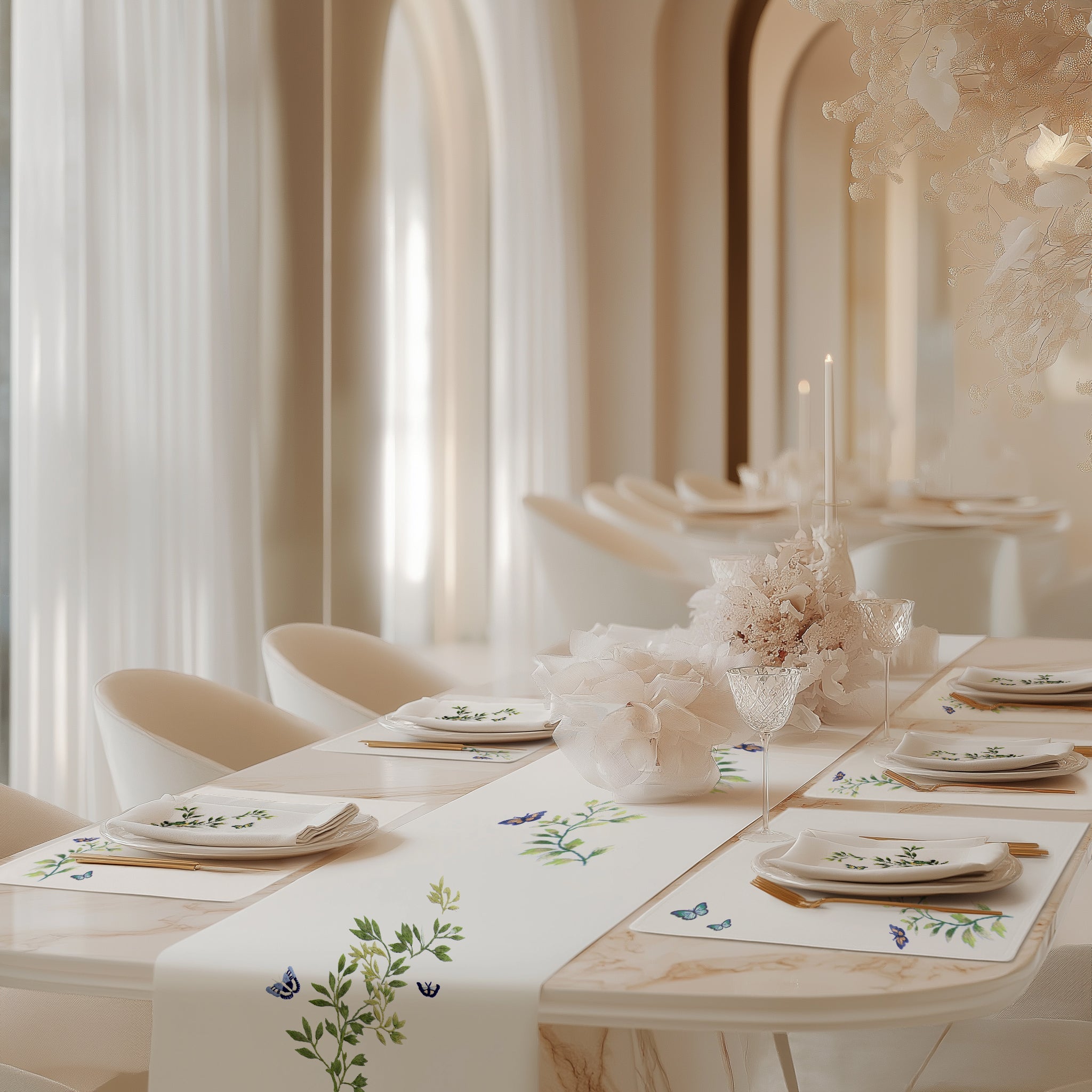
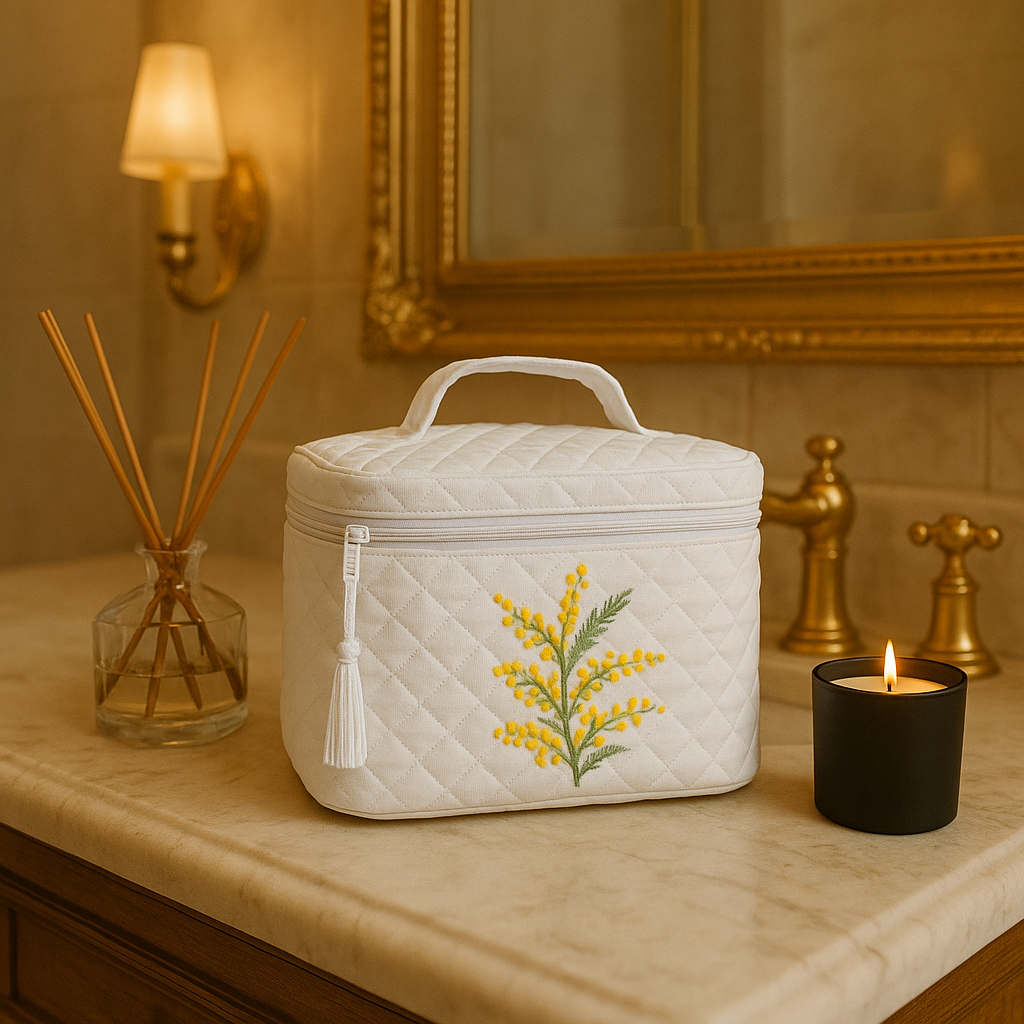
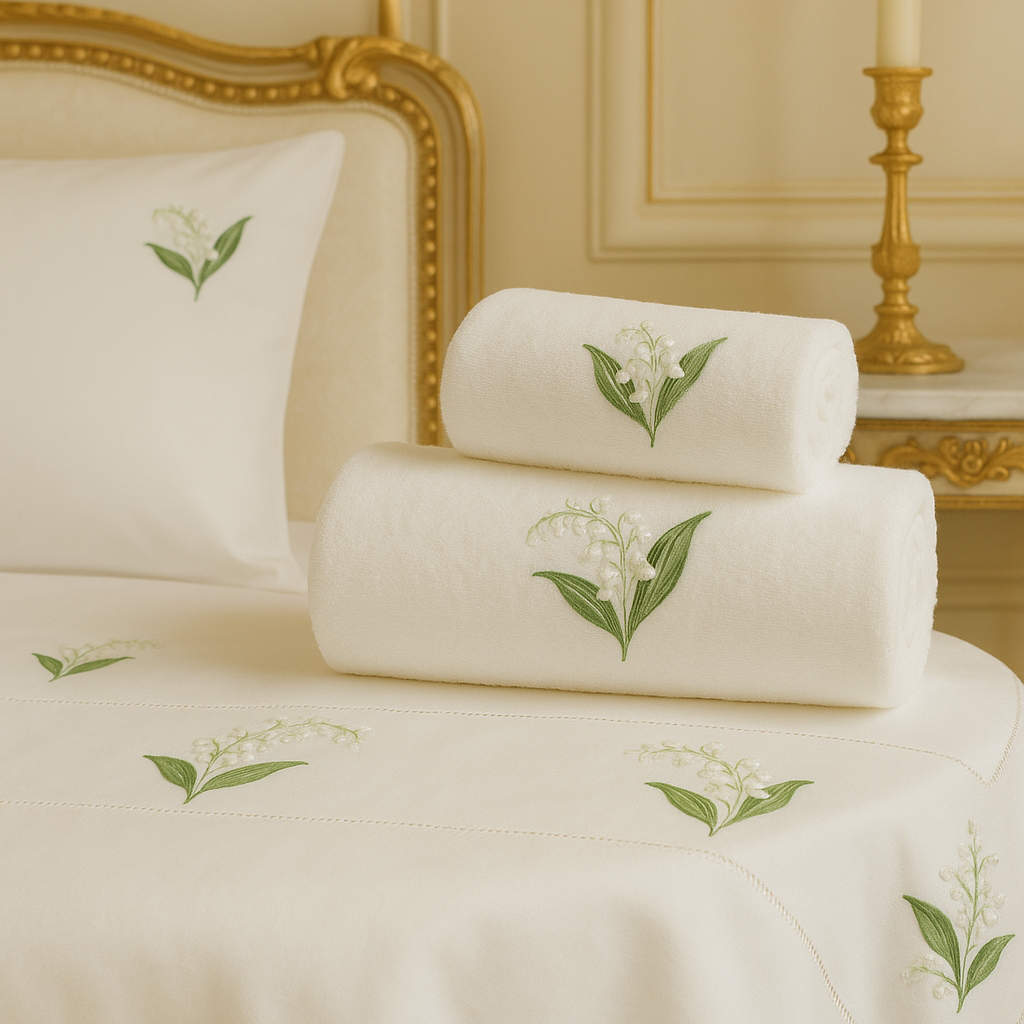
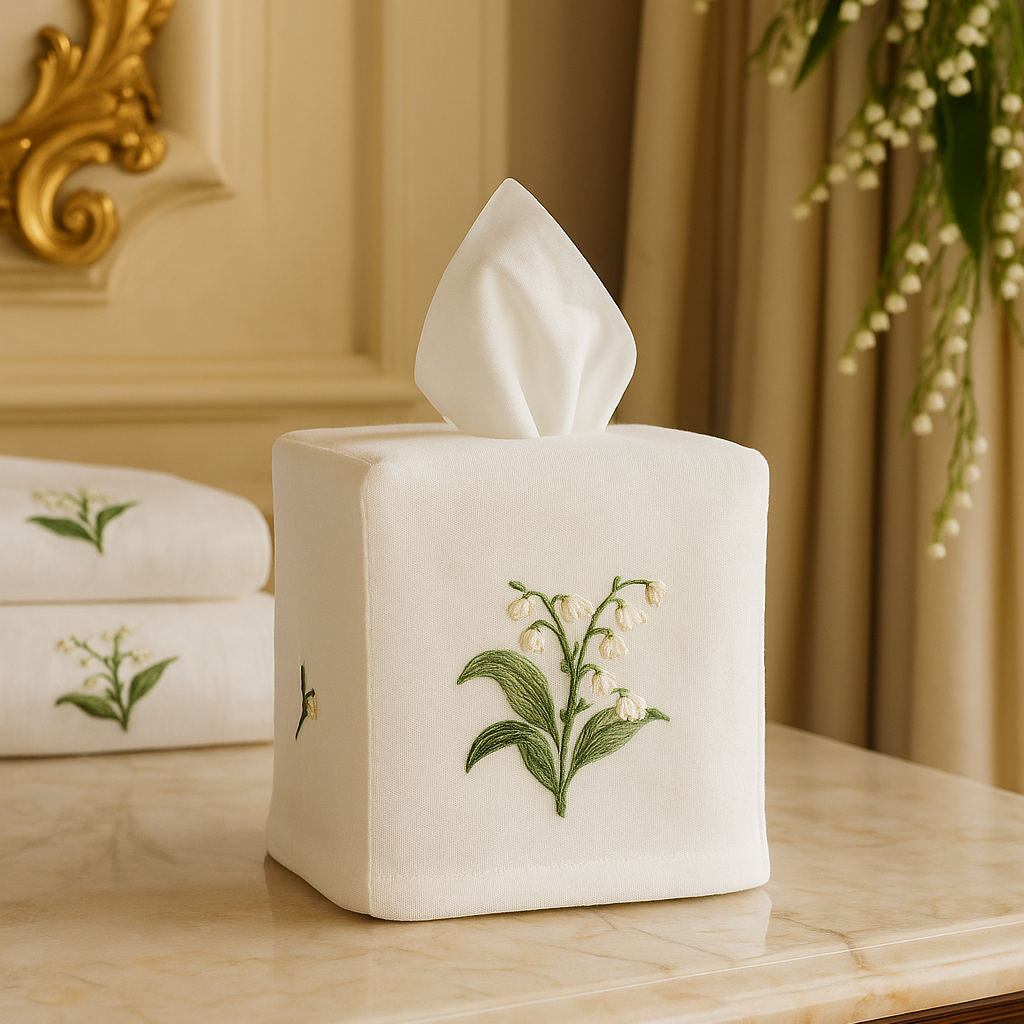

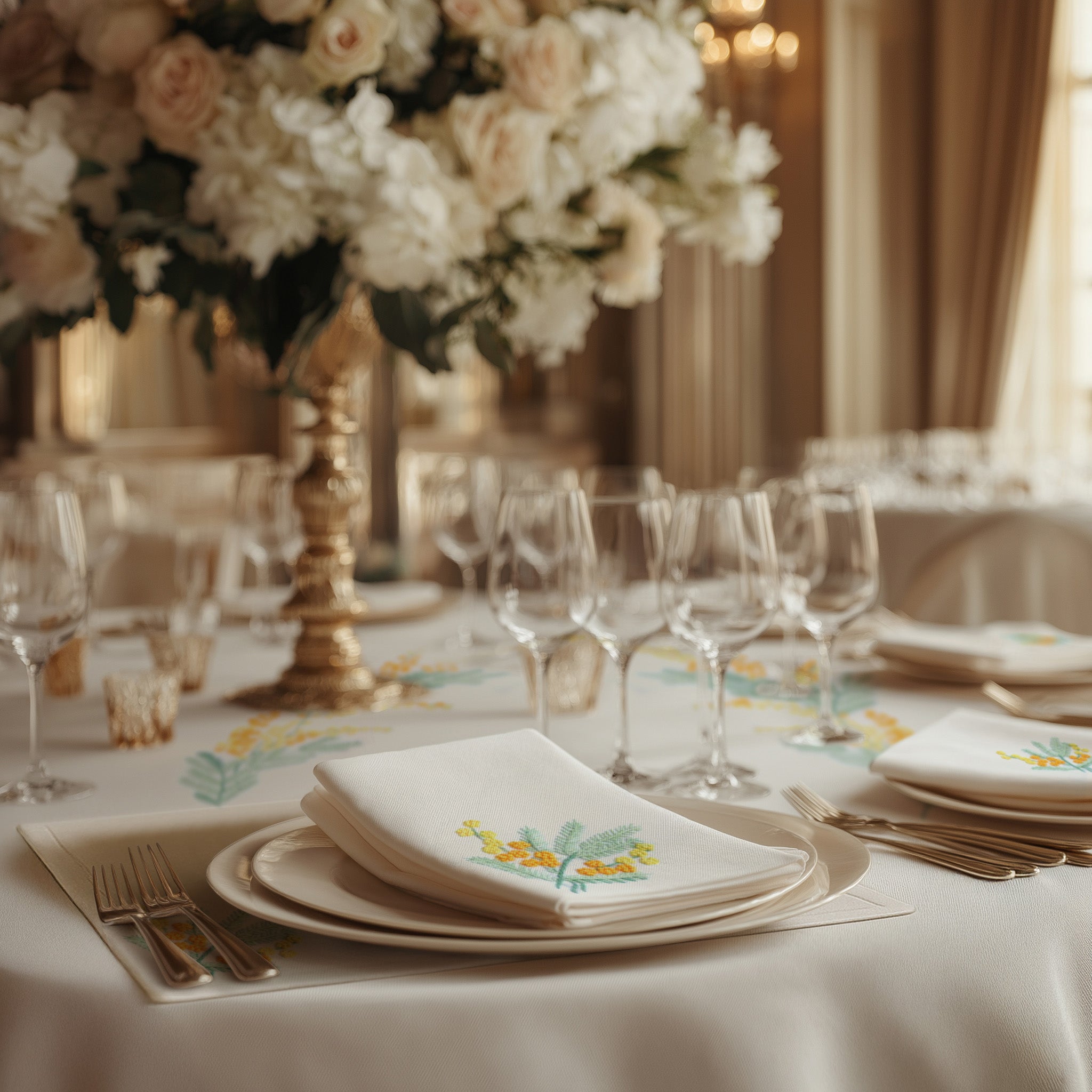

Every Valombreuse tablecloth begins as a drawing. It might be a branch of mimosa, a scatter of cornflowers, or a poppy caught just as it opens. The motif is drawn, then transferred onto a length of linen that has been woven, cut and hemmed in our own workshop.
At this point the cloth is worth roughly what the linen cost. Over the next three months, it will become something else.
Three months at the frame
The linen is stretched taut on a frame. The embroiderer threads a needle, and from then on nothing is fast.
Satin stitch has to follow the form it fills. Each stitch is angled to the curve of the petal or the leaf, so that the finished motif catches the light the way the drawing intended. The stitches lie side by side with no gaps and no overlaps, at a tension that holds the thread flat without drawing in the cloth. Where a motif is raised, it is padded first, and the padding has to be perfectly even or the surface will ripple. Along the hem, the ladder stitch: single threads drawn out of the weave, the rest bound into clusters, counted by eye.
Linen does not forgive. A needle leaves a hole in close-woven cloth, so a stitch that is pulled out never fully disappears. There is no undo. Every stitch has to be right the first time, thousands of times over, day after day, for about three months.
Twenty years before the first stitch
Three months is how long the tablecloth takes. It is not how long it took to learn to make it.
The hand at that frame has been training for twenty years. Those years went into learning how much tension a percale will take before it puckers, how thread sits differently on sateen than on linen, and how to turn the tip of a leaf so it stays sharp. Very little of this can be written down. It lives in the fingers.
This is what the price of hand-embroidered linen really pays for. You are not buying three months of someone's time. You are buying the twenty years that make those three months possible. It is also why the craft is rare: few people will spend two decades mastering something that takes three months to show.
The day it arrives
When the tablecloth reaches its new home, the first thing worth doing is turning it over. The back of an embroidery tells you how it was made.
- The reverse. Hand embroidery has a tidy back, with thread ends worked into the stitching. Machine embroidery usually leaves a stiff stabiliser backing, trimmed jump threads or a dense mat of bobbin thread.
- The relief. Hand satin stitch sits slightly raised and catches the light differently wherever the stitches change direction. Machine fill lies flat and uniform.
- The line. A motif followed by hand varies slightly from one repeat to the next. A machine motif is identical to the millimetre every time.
- The drape. Dense machine embroidery stiffens the cloth around it. Hand work leaves linen supple right up to the edge of the motif.
Ten years of Sundays
Then it goes on the table. New linen is at its stiffest. Every wash after that relaxes the fibres and softens the surface, and the embroidery settles into the weave until the motif looks less applied than grown there. Flax fibres are stronger wet than dry, which is why good linen survives decades of laundering. Hand embroidery, set to the fabric's own give and with no backing to break down, moves with the cloth instead of fighting it.
It asks for a little care in return: moderate temperatures, a gentle detergent, no bleach, and ironing on the reverse so the embroidery keeps its relief. Our guide to caring for French linen bedding takes you through it step by step.
The numbers are plainer than the word "heritage". Laid 25 times a year, a tablecloth at around €1,800 has served 750 meals after thirty years, which is €2.40 a sitting. A €150 machine-made cloth replaced every five years comes to about €1.20. The real difference is roughly a euro a meal, and for it you own one tablecloth worth handing down instead of six nobody will remember. Bed linen makes the case faster because it is used every night. Rotated with a second set, one of our hand-embroidered bedding sets spends around 2,700 nights on the bed over fifteen years.
None of this holds for a cloth that will meet felt-tip pens at children's parties, or for sheets sent to a high-heat laundry every week. Hand-embroidered linen earns its price in homes where it is used often, washed with care and kept.
Fifty years on
French flea markets are full of old household linen with monograms still crisp after a century. Someone embroidered each one by hand, and someone else looked after it.
One day a tablecloth like this will lie on a table you will never sit at, in front of people you will never meet. And someone will turn it over to look at the back.
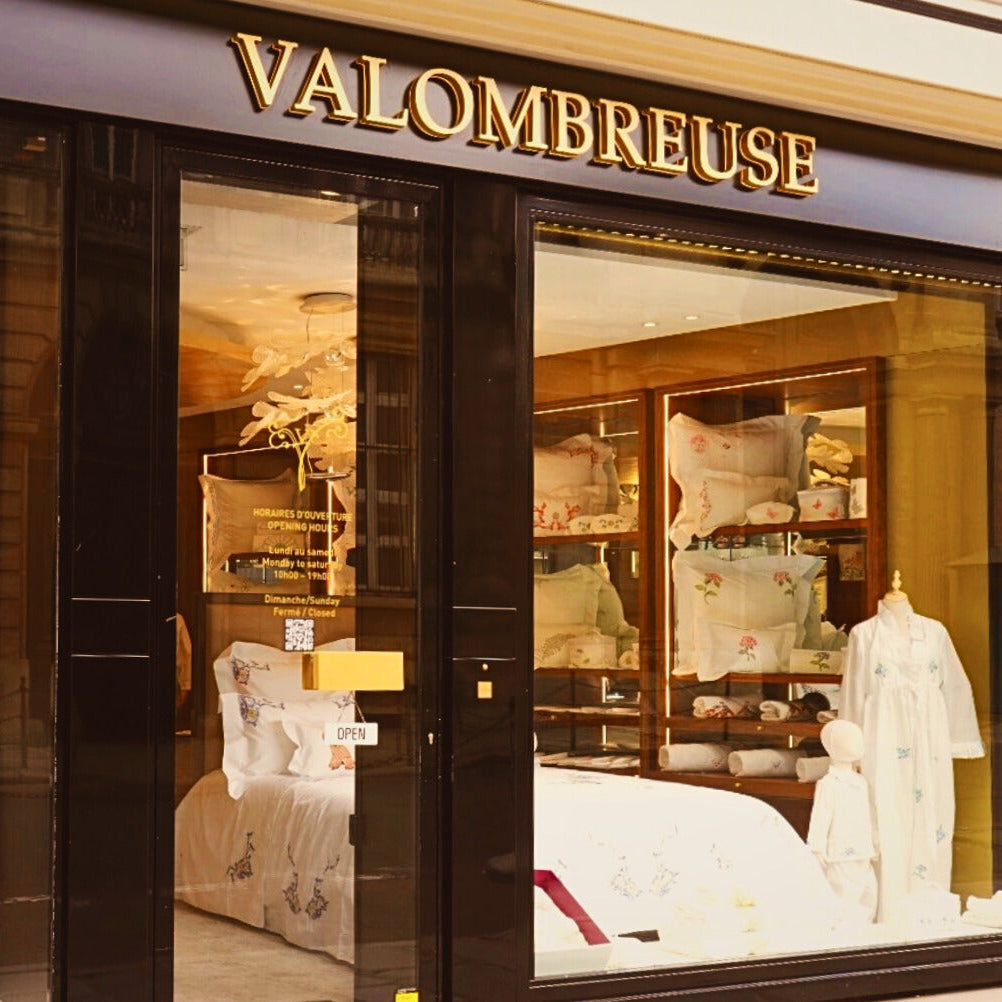
To see the difference for yourself, visit our boutique at 66 rue du Faubourg Saint-Honoré, Paris, Monday to Saturday from 10am to 7pm, and turn a piece over.

Comments
Pourquoi l’installation a fontenay sous bois